Guides
Party rental customer service calls: late trucks, damage notes and escalation
Customer service call handling for party rental: opening lines, a late delivery example, damage condition notes, repeat-backs, and when to escalate.
What to take away
- One script per call type beats one script for every call.
- Every script opens by confirming the booking number and the event date.
- The repeat-back decides the resultthe caller says the new window or charge back to you.
- Damage calls move to a written condition note before anyone talks about the deposit.
- Hand the call to the owner when injury, a lawyer, or a charge above the manager's limit appears.
A calm voice does not fix a late truck.
Conditions that must be true before the first step
Three things must be true before anyone picks up the phone. Your rental agreement must state deposit terms and the condition standard in plain words, because a vague waiver clause is one a court can set aside (contract law basics).
Whoever answers must see today's load-out sheet and tomorrow's returns. Someone in the building needs the authority to move a delivery window on the spot.
The sequence, call by call
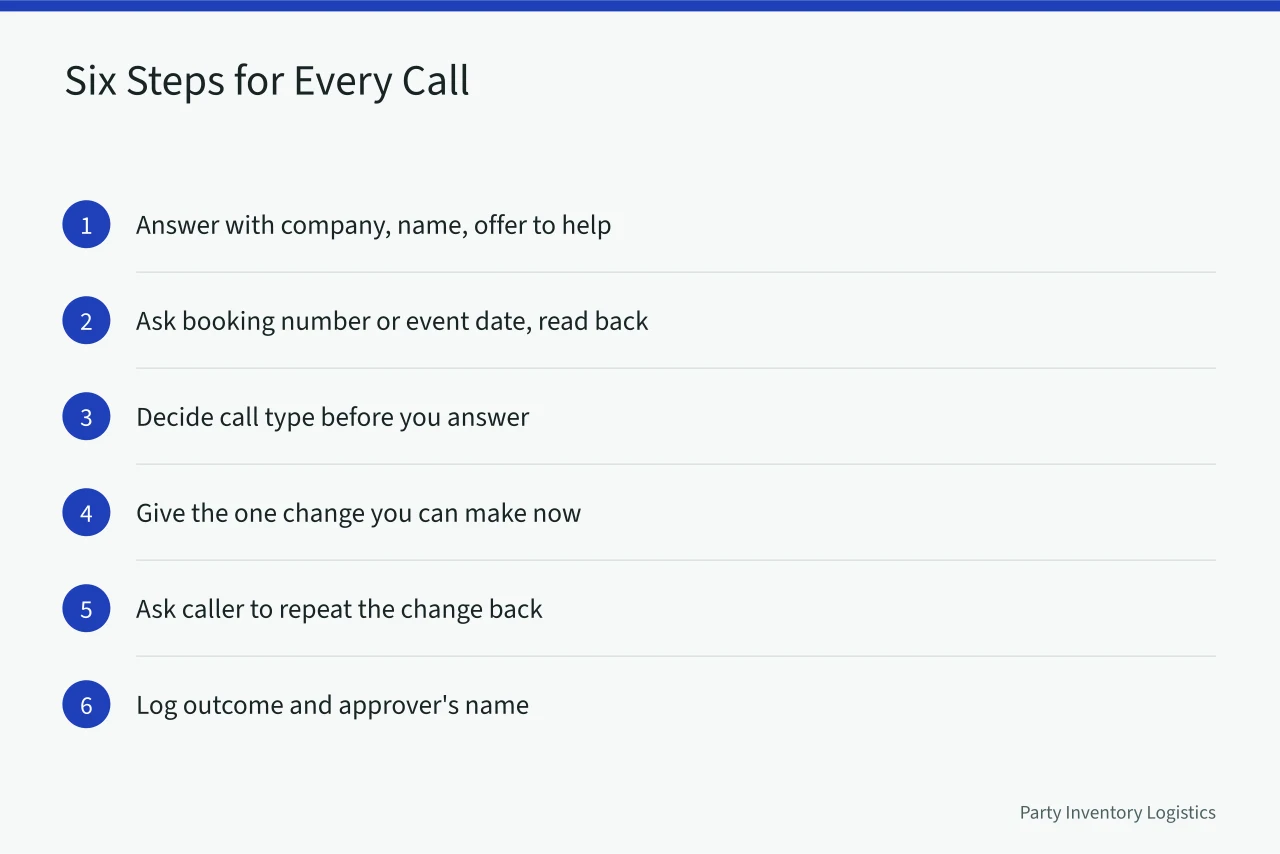
- Answer with the company name, your name, and an offer to help.
- Ask for the booking number or the event date, then read it back.
- Decide which call type you are handling before you answer.
- Give the one thing you can change right now, and only that.
- Ask the caller to repeat the change back to you.
- Log the outcome and the name of whoever approved it.
Booking changes agreed on the phone belong on the schedule the same day. The habits that keep dates from slipping are covered under Scheduling party rental work.
Call Type Opening Lines
Call type
- Late delivery
- New arrival window
- Damage complaint
- Written condition note
- Site or weather change
- A safe option
- Cancellation
- The terms they signed
- Add-on before pickup
- Today's count
What caller needs first
- Late delivery
- Checking the truck now
- Damage complaint
- Write down what you see
- Site or weather change
- Tell me ground and wind
- Cancellation
- Read you the terms
- Add-on before pickup
- Check the count while we talk
Opening line
- Late delivery
- Damage complaint
- Site or weather change
- Cancellation
- Add-on before pickup
| Call type | What the caller needs first | Opening line |
|---|---|---|
| Late delivery | A new arrival window | "I have your Saturday drop, and I am checking the truck now." |
| Damage complaint | A written condition note | "Let's write down what you see before we talk about the deposit." |
| Site or weather change | A safe option | "Tell me about the ground and the wind, and I'll tell you what holds." |
| Cancellation | The terms they signed | "Let me read you the terms on your order." |
| Add-on before pickup | Today's count | "I can check the count while we talk." |
The step that decides the result
The repeat-back: when the caller says the new window aloud, both of you hold the same fact. If the caller will not repeat it, no window was agreed.
Damage calls work the same: caller describes damage, you type it, and read it back with items in view. Waiver language that never names the damaged item is hard to defend, so the note and clause must match (types of damages).
How to check each step came out right
Four checks, all visible in the call log.
Four Call Log Checks
- Caller says new window or charge back
- Damage note has item tag and same-day photo
- Add-on appears on signed order before load-out
- Log names the person who approved the change
- The caller says the new window or the charge back in their own words.
- The damage note carries the item tag number and a photo from the same day.
- Any add-on appears on the signed order before the truck leaves the yard.
- The log names the person who approved the change.
The same failure repeated across weeks turns up in what you measure every month before it turns up in reviews.
What to do when a step goes wrong
The common failure is a promise that slips after the call ends. The truck is still loaded, or the 2 p.m. window is gone. The recovery is the reset call. The dispatcher phones the customer before the customer phones the office and states the new window.
The second failure is a damage claim that grows while you talk. The recovery is the condition-log hold. Say you have to check the condition log before you answer, then go and check it. That pause keeps a guess out of the record. Both recoveries work better where a party rental business has written its day down as procedures.
Adding to an order without pushing
Offer the add-on after solving the caller's problem, never before. Ask one question about the event, then name one item that fits. If the caller says no, log it as declined and move on.
Anything agreed on the phone goes onto the signed order before load-out, or the crew loads the wrong count. That is why party rental delivery routes get rechecked whenever an order grows.
When to stop and hand it to a professional
End the call and pass it to the owner, insurer, or lawyer as soon as any of these is true. Someone was hurt, the caller mentions a lawsuit or a state agency, or the dispute is over a charge above your manager's approval limit. The caller asks you to interpret the waiver.
A clause that shifts every risk to the customer, including your own mistakes, invites a claim that it is unfair (unconscionability).
Example: a late delivery apology
"Hello, this is [your name] at [company]. Your tent was due at 1 p.m. and is not there. The truck is now set for 3:30 p.m., and I will call you at 3 p.m. whether or not it has left the yard. If 3:30 does not work, I can bring the tables and chairs now and the tent at 7 a.m. tomorrow. Which would you rather have?"